Chapter 4: A Brief History of AI
Overview
Artificial Intelligence may feel new, but the ideas behind it have been developing for decades. The history of AI is a story of breakthroughs, setbacks, renewed hope, and rapid innovation.
Understanding where AI came from helps explain why it has suddenly become so powerful — and why today’s moment is different from all that came before.
Early Ideas (1940s–1950s)
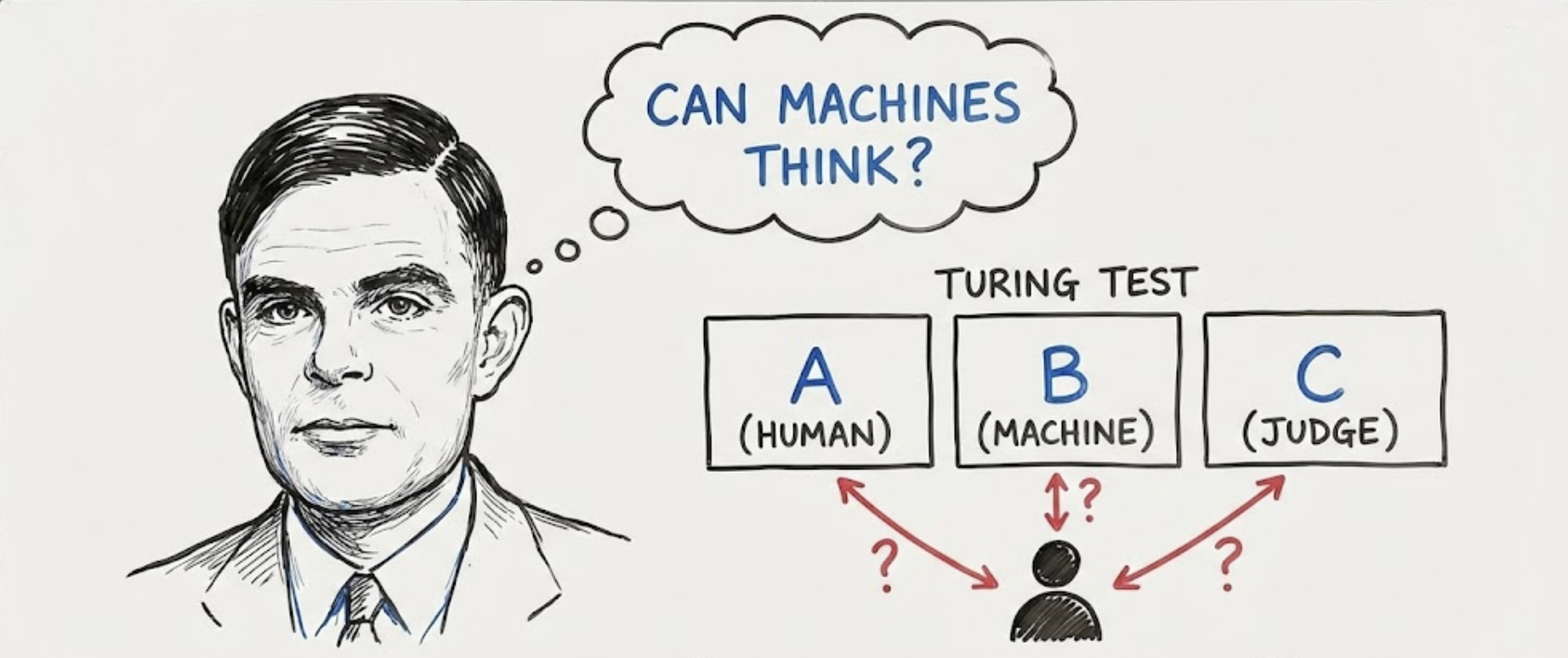
The origins of AI go back to early computing pioneers. In 1950, Alan Turing proposed the famous Turing Test — an idea for measuring whether a machine’s behavior could be indistinguishable from a human’s.
During this era, early programs began solving math problems or playing simple games like checkers, proving that machines could follow logic and rules.
The Birth of AI (1956)
In the summer of 1956, a small group of researchers met at Dartmouth College and formally coined the term “Artificial Intelligence.”
The mood was optimistic. Many believed human-level AI was just around the corner — but the field was still decades away from real breakthroughs.
The AI Winters (1970s–1990s)
Progress was slow, and expectations were high. When early systems failed to live up to the hype, funding was cut, enthusiasm faded, and AI entered long periods of stagnation known as 'AI winters.'
Even so, important groundwork was laid: expert systems, robotics research, and early machine-learning ideas that would eventually resurface in more powerful forms.
Machine Learning Rises (2000s)
With the growth of the internet, massive datasets became available. Computers grew faster, storage became cheaper, and researchers discovered new algorithms for teaching machines to learn from data.
AI systems could now recognize faces, recommend products, and understand speech more reliably than ever before.
The Deep Learning Era (2010s)
A breakthrough arrived with deep neural networks — systems with many layers that could learn complex patterns. These models dramatically improved image recognition, speech recognition, and natural language understanding.
Landmark achievements included AI beating humans at image classification (2015) and AlphaGo defeating a world champion Go player (2016). AI began to outperform humans in narrow but highly complex tasks.
The Rise of Generative AI (2020s)
Large Language Models (LLMs) like ChatGPT, Claude, and Gemini ushered in a new era of AI — systems capable of writing, summarizing, coding, translating, and creating images, audio, and video.
AI became integrated into everyday tools: smartphones, search engines, design software, productivity apps, and more. Millions began using AI daily — often without realizing it.
Mass Adoption (Today)
By the mid-2020s, AI reached a tipping point. It became part of everyday infrastructure — as common and essential as the internet or smartphones.
At work, AI acts as a co-pilot for writing, research, analysis, and creativity. At home, it powers assistants, recommendation systems, smart devices, and learning tools.
The world is now asking important questions about safety, ethics, fairness, and regulation as AI becomes more capable and more widely used.
Key Takeaway
AI has evolved from a theoretical idea to a practical, everyday technology in less than a century. Its history is marked by cycles of bold ambition, disappointment, and breakthrough innovation.
Today’s AI moment is different: the technology is widely accessible, integrated into daily life, and advancing at unprecedented speed. Understanding its past helps us navigate its future.
End of Chapter 4: A Brief History of AI