Chapter 2: What Is AI?
Overview
Artificial Intelligence (AI) is the ability of computers and software to perform tasks that normally require human intelligence—like recognizing patterns, making predictions, or generating language and images.
At its core, AI is not magic. It is a combination of data, math, and computing power working together to spot patterns and produce useful outputs.
A Simple Definition
You can think of AI as pattern recognition plus prediction.
Given enough examples, AI systems learn to answer questions like:
- What word is likely to come next in this sentence?
- Which image most likely contains a cat?
- What route will get you to your destination fastest?
- What response is most helpful given this question?
The smarter an AI system seems, the better it has become at recognizing patterns in large amounts of data and predicting what should come next.
The Three Core Ingredients of AI
Most modern AI systems rely on three essential ingredients working together:
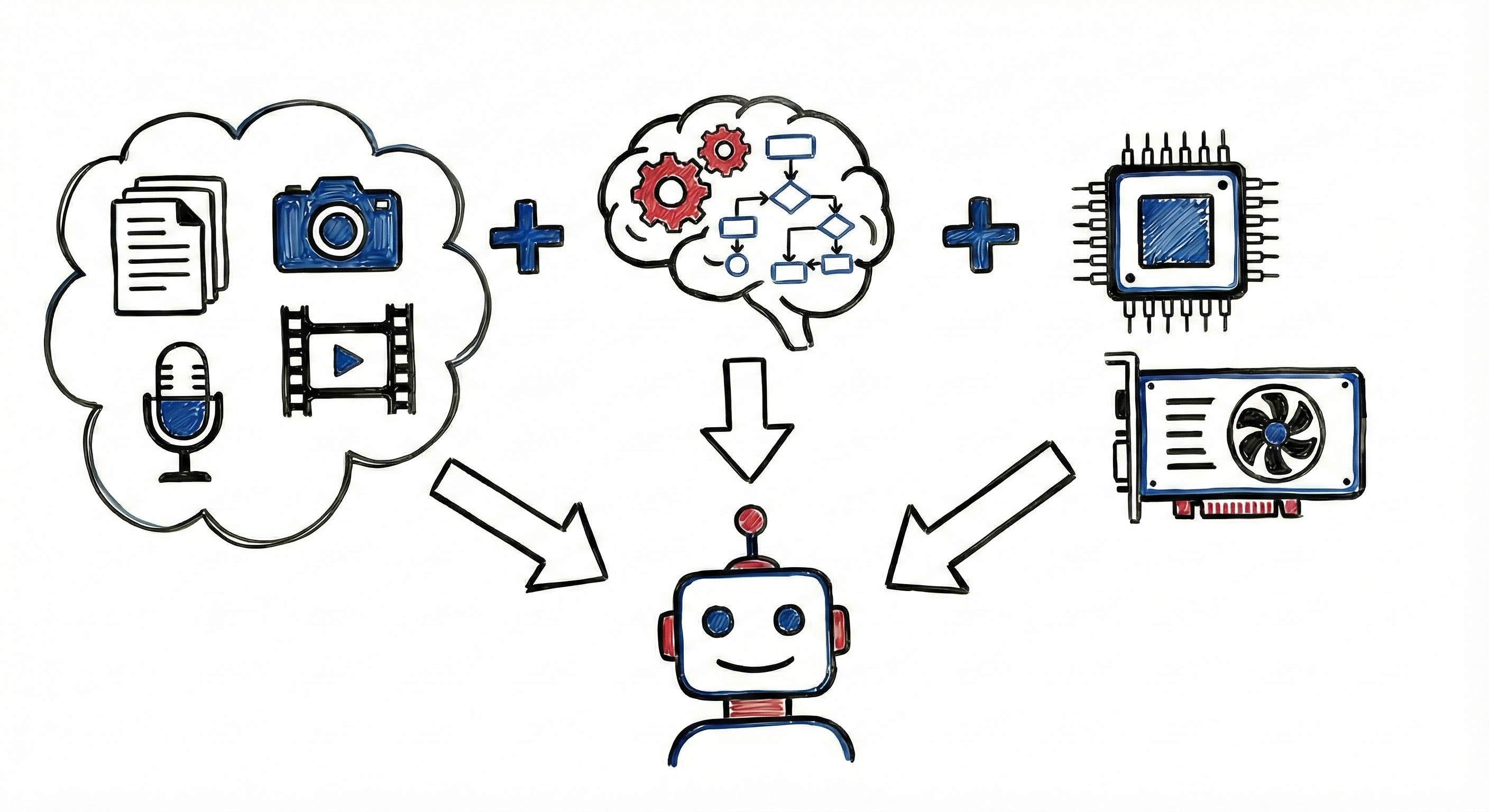
- Data – Examples to learn from. This can include text, images, audio, video, sensor data, or logs of human behavior.
- Algorithms – The rules and methods that tell the computer how to learn from the data and make predictions.
- Computing Power – The hardware (CPUs, GPUs, TPUs, and other chips) that makes it possible to process huge amounts of data quickly.
Without enough data, algorithms have nothing to learn from. Without strong algorithms, AI can’t learn useful patterns. Without computing power, even good algorithms and data are too slow to be practical.
What AI Does Well
AI is especially good at tasks where there are many examples and clear patterns. Common strengths include:
- Processing large amounts of data quickly. AI can read, compare, and analyze far more information than a person can.
- Automating repetitive tasks. Drafting emails, summarizing text, tagging images, or sorting information.
- Making predictions. Estimating travel time, suggesting the next video to watch, or forecasting demand.
- Generating content. Writing text, creating images, composing music, or suggesting code.
These strengths make AI a powerful assistant for research, writing, analysis, and creative work.
Where AI Struggles
AI is powerful, but it also has clear limitations. It struggles with:
- Common-sense reasoning. AI does not truly understand the world; it works from patterns in data.
- Nuance and context. Humor, sarcasm, culture, and subtle social cues can be misinterpreted.
- Unfamiliar situations. When asked about something far outside its training data, AI may respond unpredictably.
- Bias and bad data. If the data is incomplete or biased, the outputs will often reflect those problems.
These limitations are why human judgment, review, and context are essential when using AI, especially in high-stakes situations.
Everyday Examples of AI
Even if you don’t notice it, you likely interact with AI many times a day:
- Unlocking your phone with face or fingerprint recognition.
- Navigation apps that reroute you around traffic in real time.
- Streaming platforms recommending movies, music, or videos.
- Email services filtering spam and flagging suspicious messages.
- Chat assistants helping draft messages, summarize articles, or answer questions.
In most of these cases, AI works quietly in the background, making your tools feel smarter and more responsive.
Key Takeaway
AI is best understood as a tool for recognizing patterns and making predictions from data. It doesn’t think or understand like a human, but it can process information at a scale and speed we can’t match.
Used thoughtfully, AI can amplify your capabilities—helping you learn faster, create more, and make better decisions—while still relying on human judgment to guide how and when it is used.